Guide for academy directors: a smooth operation and monthly payments on time (free PDF)
A free, practical guide to running a music or arts academy with less administrative drag: a single schedule, closing out classes, the billing cycle and a weekly checklist. Download the full PDF.

If you run a music, dance or arts academy, you probably recognize this week: a schedule change nobody logged, a family that doesn't know what they owe, a class that was taught but doesn't show up in the teacher's account, and an overdue payment nobody remembered to collect on time.
It's not a lack of commitment. It's that the operation depends on memory, scattered WhatsApp conversations and improvised decisions. Every new student adds revenue, but also adds messages, cross-checking and room for error.
That's why we put together a free, practical guide, no sign-up required, with recommendations applied to academies with 4 to 25 teachers: how to organize daily operations and how to collect monthly payments without friction.
Practical guide for academy directors (PDF, 21 pages)
Operational efficiency, the monthly billing cycle, and a weekly and monthly control checklist — free, no email required.
1. One single official schedule
The simplest operating rule: if a change isn't in the official schedule, the change doesn't exist yet. When the real schedule is split between a spreadsheet, the teacher's calendar and a WhatsApp conversation, two people end up believing they have the correct version — and each has a different one.
Define who can create or modify schedules, what minimum information each class must have, up to what point changes are accepted, and who confirms to the family that the change went through. Chats are for talking; the schedule is for operating.
2. Manage by exception, don't review everything every day
An academy with 100 students shouldn't force its director to manually review 100 cases every morning. Operations get lighter when the team focuses its attention only on what fell outside the norm: students who didn't attend, teachers who didn't log the class, overdue payments, makeup classes without a date, and repeated absences.
3. Close out every class with a mandatory minimum record
A class isn't administratively done when the student walks out of the room — it's done when it's recorded. That record should be brief: status (attended, absent, canceled with notice, rescheduled), a short note if it needs follow-up, and a makeup request when applicable. Without that close-out, you can't calculate teacher payroll correctly or catch early warning signs of dropout.
4. Define a clear, repeatable billing cycle
Families should understand the payment system from enrollment, not discover it when the first late payment shows up. The basic policy should answer: is the monthly fee paid in advance or in arrears? What does the price include? Do absences reduce the monthly fee? What happens with late payments?
And reminders work better before the due date, not after: a notice 3 days ahead, confirmation on the due date, a pending-balance notice 2 days later, and personal contact between days 5 and 7 if it's still unresolved.
5. Apply a gradual late-payment policy
Four stages keep administration from negotiating case by case: an automatic reminder, personal contact to understand what happened, a concrete written agreement if there's an exceptional situation, and — with no payment or response — suspending the schedule reservation, communicated respectfully.
Quick weekly control checklist
- Next 7 days scheduled with no gaps or room/teacher conflicts
- Previous week's attendance records complete
- Repeated absences contacted before they turn into a dropout
- Pending makeup classes have a date, not open-ended promises
- Overdue payments sorted into: unidentified payment, likely oversight, actual delinquency
The full guide includes the monthly checklist, the exact billing reminder sequence with ready-to-use message templates, the detailed gradual late-payment policy, and the sources consulted (Stripe, QuickBooks, Mindbody, Zenoti).
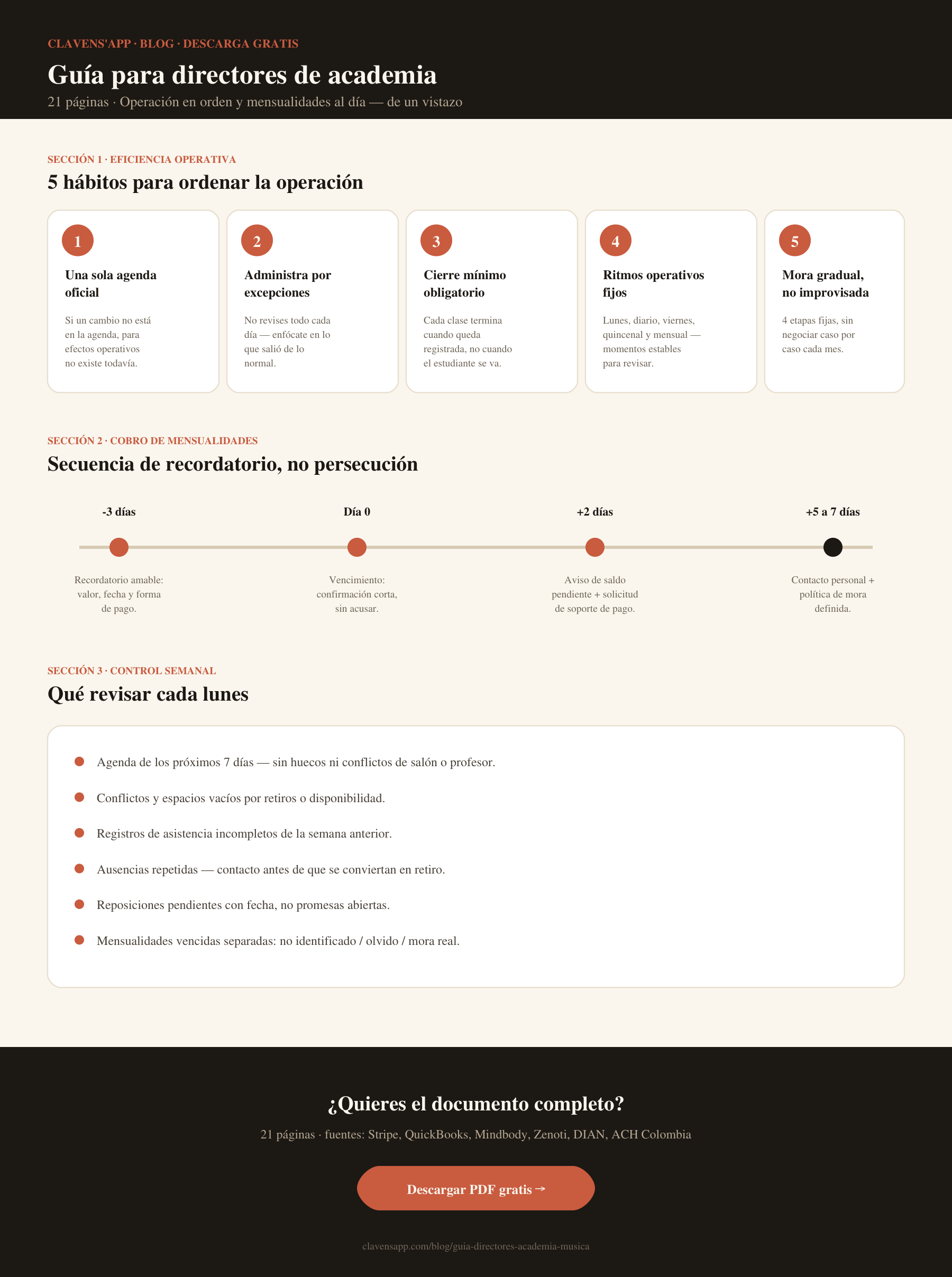 Visual summary of the guide's three main sections
Want the full document?
Frequently asked questions
If you'd rather resolve specific questions before downloading the PDF, check the FAQ at the end of this article.
Getting schedules, attendance, monthly payments and teacher pay in order doesn't take away an academy's warmth — it gives back time to better support students, families and teachers. If your academy has already passed the point where sustaining these habits manually is viable, related articles like billing and payment models, teacher payroll and student retention go deeper into each topic.
Clavens'app centralizes scheduling, closing out classes, billing for monthly plans and packages, and teacher payroll in a single system. If you want to see how it works, you can create your academy for free and set it up in under 10 minutes.